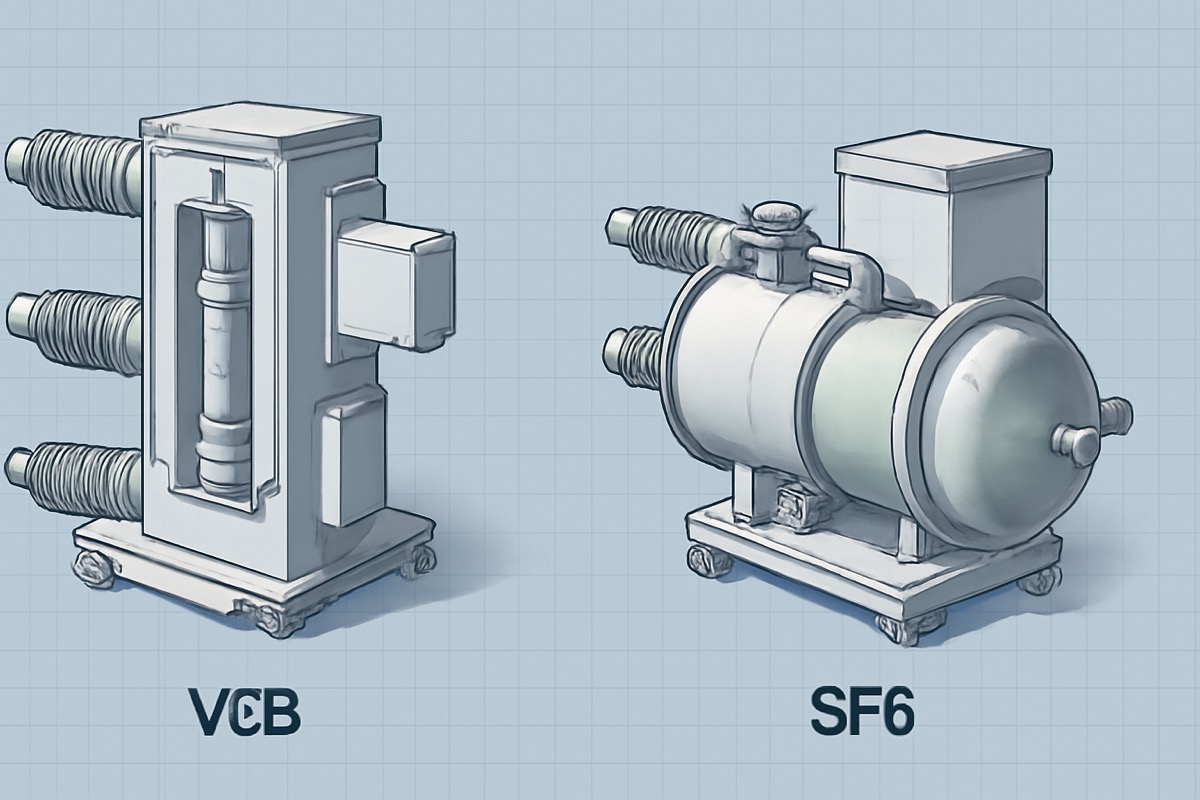
Quick Answer: VCB or SF6 — Which Should You Choose?
For 12-24 kV distribution networks, a vacuum circuit breaker (VCB) is the better choice in the vast majority of cases. It delivers longer mechanical life (10,000-30,000 operations), lower maintenance costs, and zero greenhouse gas risk. Choose an SF6 circuit breaker only when you need the compact, gas-insulated form factor for space-constrained indoor installations such as ring main units or gas-insulated switchgear (GIS). Below we compare both technologies across 10 engineering dimensions so you can make a confident selection. For background on the medium voltage switchgear landscape, see our complete guide.
What Is a Vacuum Circuit Breaker (VCB)?
A vacuum circuit breaker uses a vacuum interrupter — a sealed chamber held at approximately 10-4 Pa — to extinguish the electrical arc when the contacts separate. Because a vacuum has the highest dielectric strength of any arc-extinguishing medium, the arc is quenched rapidly at the first current zero, typically within 8-15 milliseconds.
The vacuum interrupter consists of two copper-chromium (CuCr) alloy contacts enclosed in a ceramic or glass envelope. When the contacts separate under fault conditions, a metal-vapor arc forms in the vacuum gap. Because there are no gas molecules to sustain the arc, the metal vapor condenses on contact surfaces and arc shields within microseconds of the current crossing zero. This gives vacuum interrupters the fastest arc recovery time of any medium-voltage switching technology — a critical advantage for protecting sensitive distribution equipment.
Key characteristics of vacuum circuit breakers:
- Arc-extinguishing medium: Vacuum (10-4 Pa)
- Typical voltage range: 1 kV - 40.5 kV
- Mechanical life: 10,000-30,000 operations (model-dependent)
- Common models: ZW32-12 (outdoor pole-mounted), VS1-12 (indoor switchgear)
- No gas handling: sealed-for-life vacuum interrupter, no refilling needed
NAIJI Electric's ZW32-12 is a widely deployed outdoor VCB rated at 12 kV / 630 A with 20 kA breaking capacity, and the VS1-12 serves indoor switchgear applications at up to 2,500 A and 31.5 kA breaking capacity.
Vacuum circuit breakers were first commercialized in the 1960s, and steady improvements in contact materials, vacuum processing, and interrupter design have made them the dominant technology at 12-24 kV worldwide. Today, an estimated 70-80% of all new medium-voltage circuit breakers installed globally are vacuum type.
What Is an SF6 Circuit Breaker?
An SF6 circuit breaker uses sulfur hexafluoride (SF6) gas — a dense, chemically inert gas — as both the insulating and arc-extinguishing medium. SF6 has a dielectric strength roughly 2.5 times that of air at atmospheric pressure, which allows more compact designs. When the arc forms between separating contacts, the gas absorbs the arc energy, decomposes momentarily, and recombines, effectively quenching the arc.
Key characteristics of SF6 circuit breakers:
- Arc-extinguishing medium: SF6 gas at 0.03-0.15 MPa gauge pressure
- Typical voltage range: 12 kV - 800 kV (dominant above 72.5 kV)
- Mechanical life: 3,000-10,000 operations
- Common models: LW36-12 (outdoor), SN10-10 (indoor)
- Gas management required: periodic pressure monitoring and leak detection
NAIJI Electric manufactures the LW36-12, a 12 kV outdoor SF6 circuit breaker with 25 kA breaking capacity, designed for substations and industrial power distribution.
SF6 has been the workhorse of high-voltage and extra-high-voltage circuit breakers since the 1970s. At voltages above 72.5 kV, SF6 remains the only commercially proven arc-extinguishing medium. However, at medium-voltage levels (12-40.5 kV), vacuum technology has been steadily displacing SF6 due to environmental concerns and lower lifecycle costs. The EU's revised F-Gas Regulation (2024/573) specifically targets the phase-down of SF6 in new medium-voltage switchgear, with a full ban on new SF6 equipment below 24 kV expected by 2030 in Europe.
VCB vs SF6 Circuit Breaker: Head-to-Head Comparison
The following table compares vacuum and SF6 circuit breakers across 10 critical engineering dimensions. Each parameter is based on typical 12 kV class equipment specifications — the most common voltage level in global distribution networks.
| Parameter | Vacuum Circuit Breaker (VCB) | SF6 Circuit Breaker |
|---|---|---|
| Voltage Range | 1 kV - 40.5 kV (most common: 12-24 kV) | 12 kV - 800 kV (dominant above 72.5 kV) |
| Breaking Capacity | Up to 50 kA at 12 kV | Up to 63 kA at 12 kV; higher at HV levels |
| Mechanical Life | 10,000 - 30,000 operations | 3,000 - 10,000 operations |
| Maintenance Cost | Low — sealed interrupter, no medium to replenish | Higher — requires gas pressure monitoring, leak detection, and occasional gas refilling |
| Environmental Impact | None — vacuum is inert, zero GWP | High — SF6 GWP = 23,500; atmospheric lifetime ~3,200 years |
| Physical Size | Moderate — requires external insulation (epoxy/silicone) | Compact — SF6 gas serves as both insulation and arc-quenching medium |
| Insulation Method | Vacuum (interrupter) + epoxy resin or silicone rubber (external) | SF6 gas (internal and external insulation) |
| Operating Temperature | -40 °C to +40 °C typical | -30 °C to +40 °C (gas liquefaction risk at extreme cold) |
| Price Range (12 kV class) | Lower — simpler construction, widely available | Higher — gas handling system adds cost |
| International Standards | IEC 62271-100, GB 1984 | IEC 62271-100, IEC 62271-203 (GIS) |
Vacuum Circuit Breaker: Advantages and Disadvantages
Advantages
- Long mechanical life: 10,000 to 30,000 operations, reducing total cost of ownership over 20-30 year asset life.
- Minimal maintenance: The sealed vacuum interrupter requires no medium replenishment. Routine checks are needed only every 5-8 years.
- Environmentally friendly: No greenhouse gases. Fully compliant with EU F-Gas Regulation and global environmental policies.
- Fast arc extinction: Arc is quenched in 8-15 ms at the first current zero, minimizing energy let-through.
- Safe at extreme temperatures: Operates reliably from -40 °C to +40 °C. No risk of gas liquefaction.
- Lower lifecycle cost: Lower purchase price combined with lower maintenance costs.
Disadvantages
- Voltage limitation: Currently less common above 40.5 kV (though the technology is advancing).
- Chopping current: May generate switching overvoltages when interrupting small inductive currents (mitigated with surge arresters).
- Larger external dimensions: Requires solid insulation (epoxy/silicone) around the interrupter, making outdoor units bulkier than equivalent SF6 designs.
SF6 Circuit Breaker: Advantages and Disadvantages
Advantages
- Compact design: SF6 gas provides both insulation and arc quenching, enabling smaller equipment footprints — ideal for ring main units and gas-insulated switchgear.
- High voltage capability: Proven technology from 12 kV up to 800 kV, including extra-high voltage (EHV) and ultra-high voltage (UHV) applications.
- Excellent arc quenching: SF6 has superior arc-cooling properties, enabling reliable interruption of very high fault currents.
- No switching overvoltage issues: Less likely to produce current chopping compared to VCB.
Disadvantages
- Environmental hazard: SF6 is the most potent greenhouse gas regulated under the Kyoto Protocol (GWP = 23,500). Leaks and end-of-life disposal are serious concerns.
- Higher maintenance: Requires periodic gas pressure checks, leak detection, and gas quality analysis. Gas handling needs certified technicians and specialized equipment.
- Cold climate limitations: Below -30 °C, SF6 can liquefy, losing its insulating and arc-quenching properties. Gas mixtures (SF6/N2 or SF6/CF4) may be needed.
- Toxic decomposition products: When SF6 decomposes under arcing, it can form toxic by-products (SOF2, SO2F2, HF) that must be handled carefully during maintenance.
- Higher cost: Both initial purchase price and lifecycle costs are higher due to gas handling infrastructure.
Lifecycle Cost Comparison: VCB vs SF6 over 25 Years
When evaluating circuit breakers for a distribution network, the total cost of ownership (TCO) over the full asset life (typically 25-30 years) matters more than the initial purchase price. Here is a simplified TCO comparison for a 12 kV / 630 A circuit breaker:
| Cost Component | Vacuum Circuit Breaker | SF6 Circuit Breaker |
|---|---|---|
| Initial Purchase | Baseline (1.0x) | 1.2-1.5x baseline |
| Installation | Standard — no gas handling | Requires SF6 filling equipment and trained gas handling technician |
| Routine Maintenance (per event) | Visual inspection + mechanism lubrication every 5-8 years | Gas pressure check annually + leak test + gas quality analysis every 3-5 years |
| Number of Maintenance Events (25 yr) | 3-5 events | 8-12 events |
| End-of-Life Disposal | Standard recycling — no hazardous waste | SF6 gas must be recovered by certified facility — regulated hazardous waste in many jurisdictions |
| Total Lifecycle Cost | Baseline (1.0x) | 1.4-1.8x baseline |
The lifecycle cost advantage of vacuum circuit breakers becomes even more pronounced in networks with high switching frequency (such as capacitor bank switching or motor starting), where the VCB's longer mechanical life (10,000-30,000 operations) means the interrupter can last the full 25-year asset life without replacement, while an SF6 breaker may need a mid-life overhaul.
Regulatory Trends: The Shift Away from SF6
Several regulatory developments are accelerating the transition from SF6 to vacuum technology in medium-voltage applications:
- EU F-Gas Regulation (2024/573): Phases down SF6 in new medium-voltage switchgear. New SF6 equipment below 24 kV will be banned in Europe by 2030, with higher voltage levels following.
- IEC 62271-4 (Ed. 2): Updated standard on SF6 handling procedures, imposing stricter requirements on gas recovery, recycling, and reporting.
- Corporate ESG policies: Many utilities and industrial companies have adopted voluntary SF6 reduction targets as part of their environmental sustainability programs.
- Carbon pricing: In jurisdictions with carbon markets (EU ETS, California Cap-and-Trade), the cost of SF6 leakage is increasingly priced into equipment procurement decisions.
These trends make vacuum technology an increasingly future-proof choice for new medium-voltage installations, regardless of current cost comparisons. For a full timeline and alternative technology breakdown, read our SF6-free switchgear guide.
Selection Guide: Which Breaker for Which Application?
Choose a Vacuum Circuit Breaker When:
- Voltage is 12-24 kV — VCB is the dominant technology in this range
- Frequent switching is required — Motor switching, capacitor bank switching, or arc furnace supply where 10,000+ operations are needed
- Outdoor pole-mounted installation — Models like the NAIJI ZW32-12 are purpose-built for this role
- Environmental compliance matters — When the project requires SF6-free solutions per EU F-Gas Regulation or company ESG goals
- Extreme cold environments — VCB works down to -40 °C without performance degradation
- Lowest lifecycle cost is the priority — Typical TCO is 30-50% lower than SF6 over a 25-year service life
Choose an SF6 Circuit Breaker When:
- Space is extremely limited — Ring main units and compact indoor switchgear where gas insulation reduces physical dimensions
- Voltage exceeds 40.5 kV — High-voltage and extra-high-voltage transmission applications
- Gas-insulated switchgear (GIS) design — Where the entire switchgear assembly is SF6-insulated
- Very high breaking capacity is needed — Some EHV applications require breaking capacities that only SF6 can achieve cost-effectively
NAIJI Electric VCB and SF6 Circuit Breaker Solutions
With over 25 years of manufacturing experience, NAIJI Electric offers both vacuum and SF6 circuit breaker solutions for 12-24 kV applications:
- ZW32-12 Outdoor VCB — 12 kV / 630 A / 20 kA, pole-mounted, spring mechanism, 10,000 operations mechanical life
- ZW32-24 Outdoor VCB — 24 kV / 630 A / 20 kA, enhanced insulation for higher voltage networks
- VS1-12 Indoor VCB — 12 kV / up to 2,500 A / 31.5 kA, draw-out or fixed mounting for switchgear cabinets
- LW36-12 SF6 Circuit Breaker — 12 kV / 630 A / 25 kA, outdoor installation for substations
- XGN15-12 Ring Main Unit — 12 kV SF6-insulated compact RMU for urban cable networks
All products are manufactured to IEC 62271 standards with ISO 9001 certified quality management, and exported to 20+ countries worldwide. Contact our engineering team for selection guidance and project quotations.